Let’s return to the stage

Only there does dance rediscover its true identity

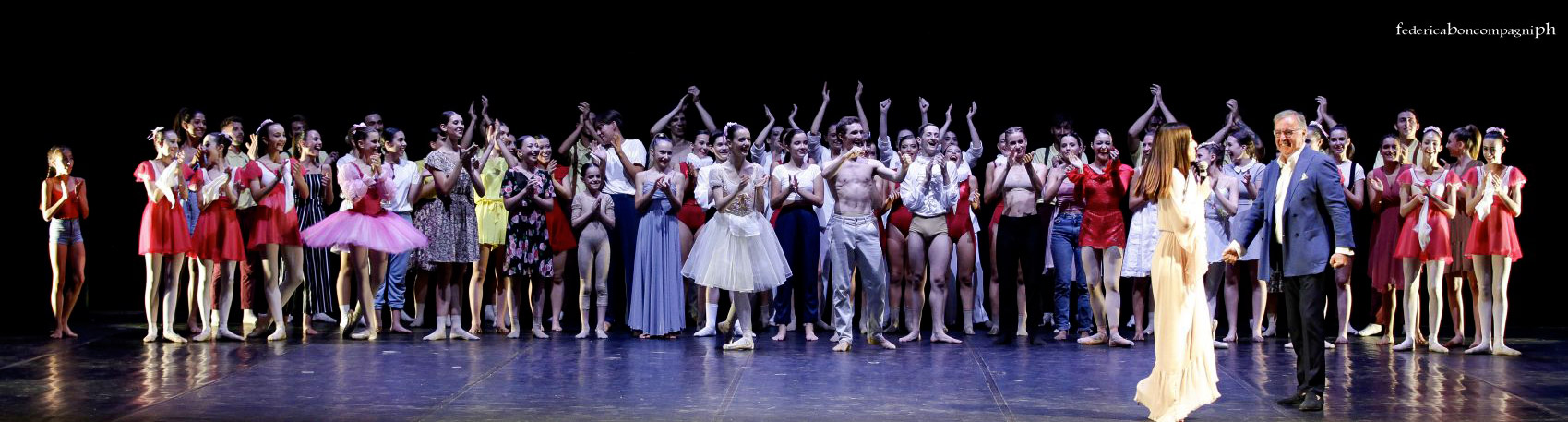
Since 1992, the Spoleto competition has been a key milestone in a dancer’s training path due to its prestige and international reputation — almost a required step for future stars of dance.

There are also scholarships, job contracts, cash prizes, and admissions to European academies.

Winning in Spoleto is a mark of quality and professionalism.

The History

The first edition of the International Dance Competition, linked to the International Dance Week, was held in Rieti from 1992 until 1997. The Artistic Direction was entrusted to Alberto Testa, and the General Direction to Paolo Boncompagni.

After a few editions held in Perugia, in 2003 the Competition moved to Spoleto, still under the General Direction of Paolo Boncompagni and with Professor Alberto Testa as Artistic Director. Spoleto became the ideal venue for the competition, which also changed its name to the International Dance Competition Spoleto.

Spoleto is home to the Festival dei Due Mondi and other important cultural events known worldwide. The competition rightfully became part of a context where culture and art are a vital force, becoming one of the four most important international events in the city.

In 2012, after 21 years as Artistic Director, Professor Alberto Testa stepped down and became Honorary President, appointing Irina Kashkova as the new Artistic Director. The new director introduced a number of important innovations. In 2010, the competition became the only Italian member of the International Federation Ballet Competition, a federation that brings together the most prestigious competitions in the world.

Participation grew, along with the quality of the dancers coming from all over the world (Russia, Germany, Brazil, China, Latvia, Ukraine, Belarus, Bulgaria, the United States, Slovenia, etc.). The format and regulations of the competition were updated to better reflect the times.

Starting in 2021, the International Dance Competition Spoleto has organized an edition in Beijing in collaboration with Chinese partners: the International Dance Competition Spoleto-China, now in its 5th edition. The winners, selected by an Italian and Chinese jury, participate in the Spoleto competition free of charge.

In 2025, the International Dance Competition Spoleto plans to hold an edition of the competition in Sicily, specifically in Caltanissetta, to provide study and job opportunities for Sicilian dancers.

About us

Irina Kashkova – Artistic Director

Irina Kashkova

Paolo Boncompagni – General Manager

Paolo Boncompagni

Our Winners and Jury Over the Years

What truly enhances the prestige of the competition are its winners – or rather, the laureates – who have emerged over the past 34 years. Many of these dancers now hold prominent positions in opera houses and ballet companies around the world.

Below is the list of winners, starting from the 1992 edition of the International Dance Week up to the winners of 2025.

1992 Aidar Akmetov ( russia)e Ambra Vallo,
1993 Gaia Straccamore
1994 Valentina Scaglia
1995 Federico Bonelli
1996 Lukas Timulak Cecoslovaccia-Ignace Cedric (Francia) e Amaya Ugartece (Spagna)
1997 Fabio Grossi
1998 Alessio Carbone
1999 Alessandra Tognoloni
2000 Montagnoli Ilenia
2001 Martina Baglioni
2002 Asta Pajunen (Finlandia)
2003 Salvatore Manzo
2004 Alessandro Riga
2005 Zaloa Fabbrini
2006 Julia e Laeticia De Andrade (Brasiele)
2007 Young Gyu Choi (Cina)
2008 Luca Della Corte
2009 Riccardo Ambrogi – Evelina Godunova (Lettonia)
2010 Claudio Coviello
2011 Timofej Andrjasenko (Lettonia)
2012 Francisco Seabastiao (Portogallo)
2013 Simone Acri (Giappone)
2014 Artemj Pizev (Russia)
2015 Sohn Deaminn
2016 Ildar Tagirov (Russia) – Nikita Boris (Stati Uniti d’America)
2017 Gabriele Rolle
2018 Tabachuc Vsevolod (Russia)
2019 Gabriele Fornaciari
2020 Non disputato x pandemia
2021 Nico Benedetti
2022 Francesco Giammattei
2023 Lina Pengel (Germania)
2024 Riccardo Rotundu Fati Ouchane (Bulgaria)
2025 Nicola Torretti

Equally illustrious are the jurors who have served on the 34 exceptional panels:

Eleonora Abbagnato, Annamaria Galeotti, Sergey Bobrov (Bulgaria), Enrico Morelli, Li Ying (Cina), Kathy Bradney (Svizzera), Steffy Sherzer (Germania), Konstantin Uralsky (Russia), Eric Vu-an (Francia), Paola Jorio, Mauro Astolfi, Roberto Fascilla, Valentina Kaslova (Russia), Tursinbek Nurkalijev (Kazakistan), Lukas Timulak (Cecoslovacchia), Sergey Usanov (Russia), Irek Mukamedov (Russia), Michele Pogliani, Pedro Carneiro (Portogallo), Francesco Ventriglia, Margherita Parrilla, Pompea Santoro, Tadeus Matacz (Germania), Jae Kun Park (Korea), Fabrizio Monteverde, Nadja Sajdakova (Germania), Gigi Caciuleanu (Romania), Micha va Hoeche (Belgio), Paul Chalmer (USA), Vladimir Derevianko( Russia), Luc Bouy (Francia), Anna Maria Prina, Susan Sentler (Inghilterra), Robert North USA), Yannik Boquin (Francia), Konstance Vernon( Germania), Liliana Cosi, Elisabetta Terabust, Amedeo Amodio, Lucien Duthoit(Francia), Jean Philippe Halnaut(Francia), Vladimir Vassilev (russia), Ekaterina Maximova(Russia), Zarko Prebil (Russia), Raffaele Paganini, Joseph Fontano, Anna Razzi, Denis Ganyo (FRancia), Giuseppe Carbone, Marika Besobrasova (Montecarlo), Vyaceslv Gordeev (Russia), Oleksy Bessmertni (Germania), Andris Liepa, Igor Yebra, Mari Grazia Garofoli, Sara Zuccari, Julio Bocca (Argentina), Sergey Bondur (Ukraina), Katherin Bennetts (USA), Clotilde Vayer ( Francia), Renato Zanella, Giuseppe Picone, Max Volpini, Mauro De Candia, Svetlin Ivelinov(Bulgaria), Reginaldo Oliveira(Brasile).

Collaborations & Sponsor

Collaboratori Istituzionali